
Belonging is Prevention
Pride has always meant more to me than visibility.
It means survival. It means joy that refuses to disappear. It means people finding each other across generations and saying, in a thousand different ways, you do not have to become smaller to be loved here. It means building lives and communities in the face of systems that have too often tried to isolate us from ourselves and from each other.
As a queer woman leading Elevate Youth Services, this work is deeply personal to me. I know what it feels like to move through the world searching for signs of safety, for spaces where you can exhale fully and stop performing versions of yourself that feel more acceptable, less complicated, less true. I also know there is extraordinary power in being met with real belonging, with community that does not merely “include” you, but delights in your existence and makes room for your becoming.
That experience changes people. It changes what becomes imaginable for a life.
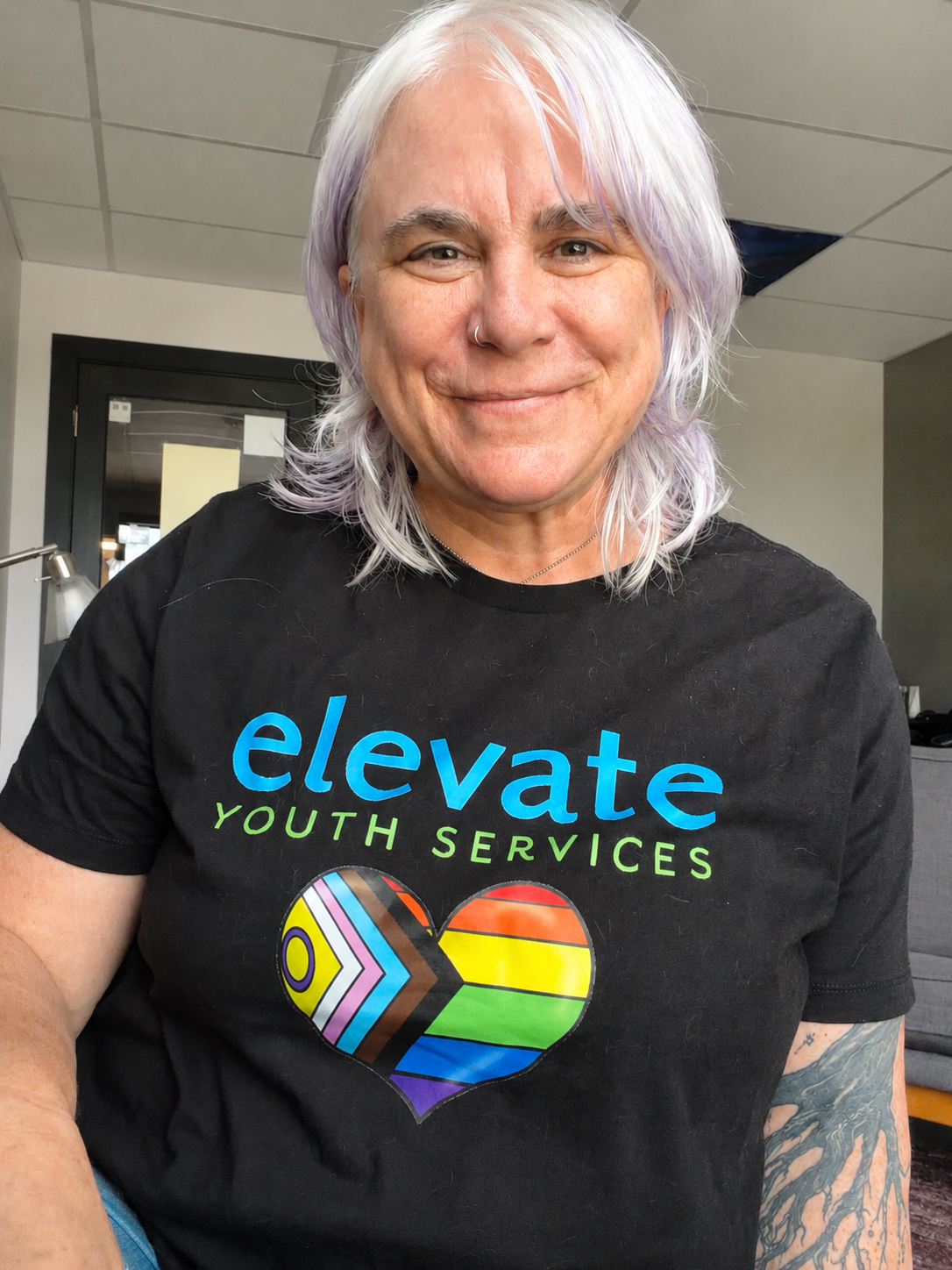
Favor Ellis, Executive Director of Elevate Youth Services, rocking a new staff tee for tomorrow’s Pride Parade in Montpelier.
At EYS, we work with young people navigating homelessness, substance use, mental health struggles, family rejection, poverty, violence, and profound disconnection. LGBTQ+ youth are disproportionately impacted by all of these realities, not because there is something inherently fragile about queer or trans young people, but because so many of our systems are still organized around punishment, scarcity, and exclusion rather than care.
And yet, queer young people continue to create beauty anyway. They continue to imagine new worlds anyway. They continue to find one another anyway.
That resilience is worthy of celebration, but I also want to be clear that young people should not have to survive abandonment in order to deserve community. They should not have to prove their worthiness through suffering.
Too often, we talk about prevention in ways that strip away humanity. We reduce it to programming, interventions, metrics, and outcomes, when the truth is that prevention begins much earlier and much closer to the heart. Prevention looks like a young person knowing there is a place they can go where they will not be shamed for who they are. It looks like relationships built slowly and honestly over time. It looks like adults who stay connected even when things get messy. It looks like chosen family, mutual aid, creativity, shared resistance, laughter, food passed around a table, joyful music playing in the background, and spaces where young people are allowed to exist without constantly defending their humanity.
Belonging is prevention because isolation is fertile ground for harm.
When young people feel disconnected from themselves, from community, from possibility, harm grows easily there. Shame grows there. Despair grows there. But when people experience genuine connection, when they are seen clearly and loved without condition, something else becomes possible. The nervous system softens. Creativity returns. Hope returns. Futures begin to expand again.
This is especially true for queer and trans youth, who are so often told directly and indirectly that they are too much, too confusing, too political, too inconvenient, too different to belong comfortably in the world as it currently exists.
But what if the problem is not queer young people?
What if the problem is a culture that has forgotten how sacred human difference actually is?
Pride, at its core, invites us into a different imagination. One where liberation is collective. One where community care matters more than respectability. One where we understand that our lives are bound up in one another, and that every young person deserves not just survival, but joy, tenderness, beauty, safety, and the freedom to become fully themselves. Every young person deserves love.
At EYS, we are trying to build that kind of ecosystem every day. Not perfectly, but earnestly. A community where young people can encounter not only services, but relationship. Not only crisis response, but connection. Not only temporary relief, but the possibility of a life rooted in dignity, creativity, and belonging.
This Pride Month, I am thinking about all the people who made it possible for me to exist as myself, and all the people who are still fighting to create a world where young people do not have to choose between authenticity and safety. I am thinking about queer elders, chosen family, organizers, artists, youth workers, and young people themselves, whose courage continually expands what freedom can look like.
And I am reminded again that belonging is not soft or secondary work. It is transformative work. It is life-saving work. It is the work of building a world where more people can remain connected to themselves, to each other, and to the possibility that their lives matter immensely.
That is what we celebrate during Pride.
Not just visibility, but the beautiful and ongoing act of keeping each other alive.
